Patient identification card for reception
A one-page reminder to keep at the front desk, based on the RACGP Standards: three checks, every time.
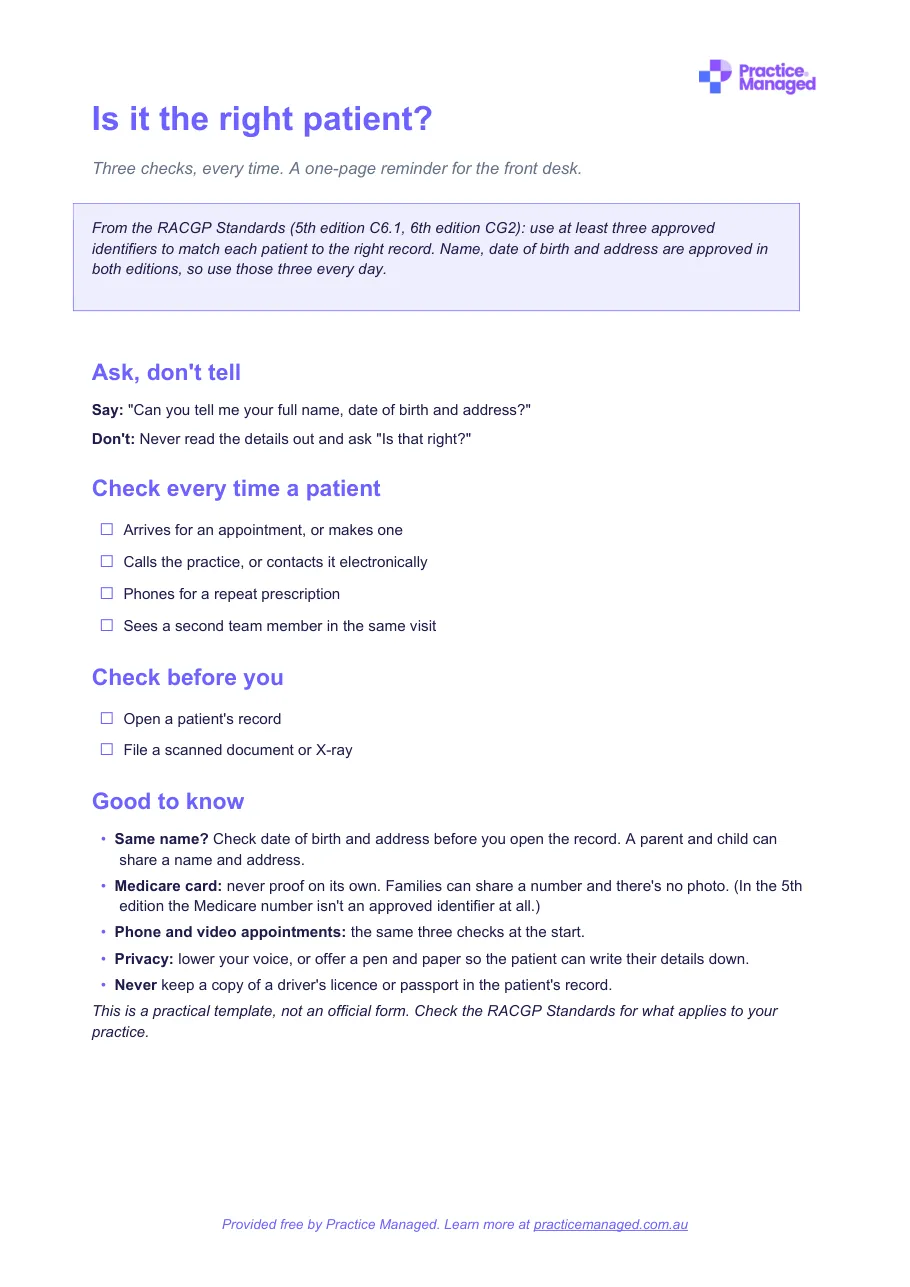
What's inside
- What to say, and what not to do: ask the patient to tell you their details, never read them out.
- When to check: arriving, booking, calls, repeat prescriptions, a second team member, opening a record and filing documents.
- Same names, Medicare cards, phone and video appointments, and privacy at the desk.
Who fills it in, and when
Every receptionist uses it, every day, and so can anyone who answers the phone or files documents. Keep it at the front desk and go through it with each new receptionist. Check every time a patient arrives, books, calls, phones for a repeat prescription or sees a second team member in the same visit, and before you open a record or file a document. If the desk is busy, lower your voice or offer a pen and paper so the patient can write their details down.
How to use it
- Print it and keep it at the front desk.
- Go through it with every new receptionist.
- Use name, date of birth and address every day.
Patient identification card for reception
Word · 73 KB · free
Which RACGP Standards it helps with
Supports 5th edition criterion C6.1 and 6th edition criterion CG2, both called Patient identification. Both ask for at least three approved identifiers. Name, date of birth and address are approved in both editions, so the card uses those three every day.
- 5th edition: C6.1 Patient identification
- 6th edition: CG2 Patient identification
An example
Example only: a caller asks for a repeat prescription. Reception asks, "Can you tell me your full name, date of birth and address?" Two records share that name and address, a parent and child, so reception checks the date of birth before opening one. On a video appointment, the same three checks happen at the start.
Common mistakes to avoid
- Reading the details out and asking "Is that right?" instead of asking the patient to tell you.
- Taking a Medicare card as proof on its own: families can share a number and there's no photo.
- Keeping a copy of a driver's licence or passport in the patient's record.
Goes well with
It goes with our guide Patient identification in a GP practice: getting it right every time.
Want to know where the rest of your practice stands? Take the free readiness check: ten yes-or-no questions, your score straight away, and a to-do list sent to your inbox.