Asking about Aboriginal and Torres Strait Islander status: reception script
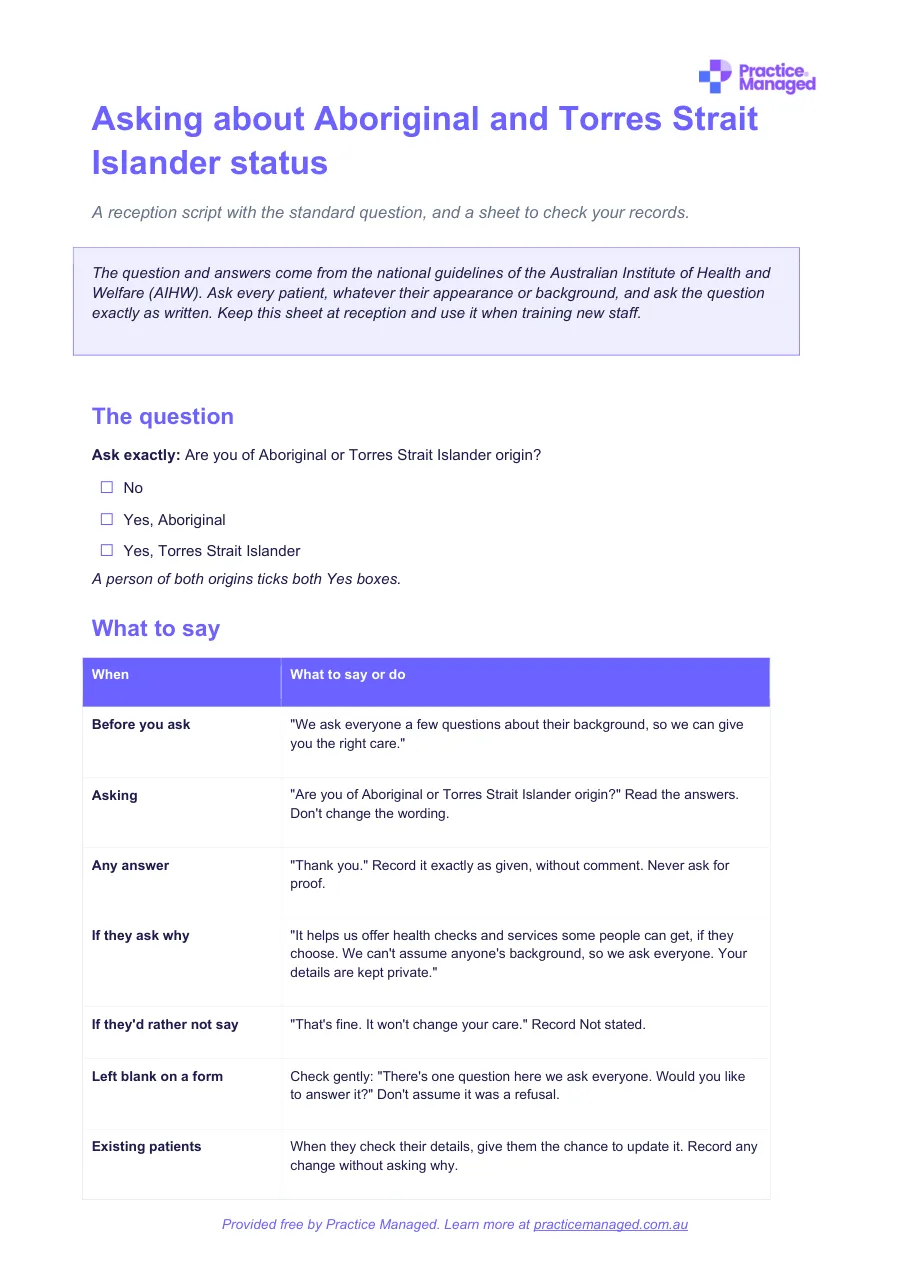
The standard question from the national guidelines, what to say in each situation, and a simple sheet to check your records.
What's inside
- The exact question and answer options, from the Australian Institute of Health and Welfare's guidelines.
- What to say before you ask, if someone asks why, if they'd rather not say, and if the form is left blank.
- A records check sheet and a team training log.
Who fills it in, and when
Reception staff use it with every new patient, and when existing patients check their details. A senior team member uses the records check sheet now and again, and the team training log records who has been trained. Use it to train new staff, and ask the question exactly as written. Use the record number in the check, never the patient's name.
How to use it
- Keep it at reception and use it to train new staff.
- Ask every patient, exactly as written.
- Check a sample of records now and again.
Aboriginal and Torres Strait Islander status: reception script
Word · 74 KB · free
Which RACGP Standards it helps with
Supports 5th edition criterion C7.1 (Content of patient health records) and 6th edition criteria CG3 (Facilitating complete patient health records) and PP3 (Respectful, culturally appropriate and culturally safe care). CG3 asks practices to routinely record status in a codable field. The 5th edition asks practices to routinely record status in the patient health record, and the question and answers come from the Australian Institute of Health and Welfare's national guidelines.
- 5th edition: C7.1 Content of patient health records
- 6th edition: CG3 Facilitating complete patient health records
- 6th edition: PP3 Respectful, culturally appropriate and culturally safe care
An example
Example only, records check: record number 20871, status recorded: yes, in the set field: yes, blank form followed up: not needed, action needed: none. If a patient asks why, reception might say: "It helps us offer health checks and services some people can get, if they choose."
Common mistakes to avoid
- Asking only the patients you think might be Aboriginal or Torres Strait Islander: ask everyone.
- Changing the wording of the question or the answer options.
- Taking a blank form as a refusal: check gently, and record Not stated only if they'd rather not say.
Goes well with
It goes with our guide Asking about Aboriginal and Torres Strait Islander status: how and why.
Want to know where the rest of your practice stands? Take the free readiness check: ten yes-or-no questions, your score straight away, and a to-do list sent to your inbox.