Patient record audit template
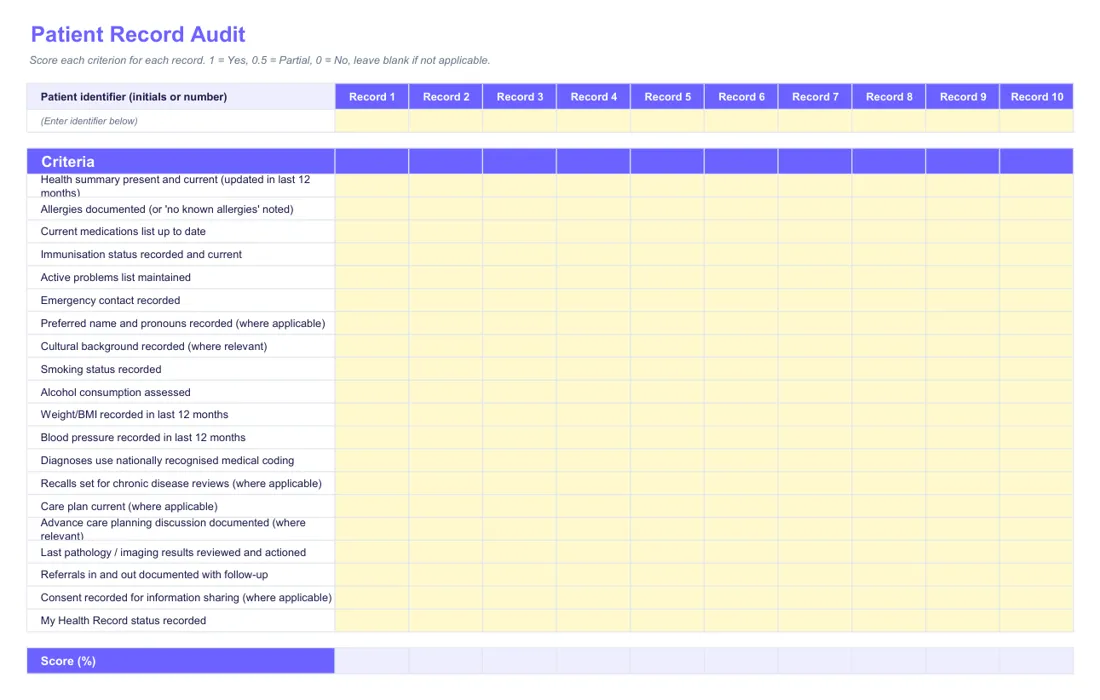
A sample audit of patient records against 20 clinical governance criteria, such as allergies, current medicines, immunisations, care plans and referrals. The scores work themselves out.
What's inside
- Audit: up to 10 records, each criterion scored Yes, Partial or No, with a percentage for each record.
- Summary: how the practice scores across every record audited.
- Findings: room to note patterns and gaps.
- Sampling guidance: how to pick records fairly across your clinicians.
Who fills it in, and when
A GP, nurse or practice manager with access to the clinical records can run it. Each audit looks at 5 to 10 records, and the file says to run it at least every three months so you build up a trend. Fill in the audit date and auditor on the Summary tab each time. For a small practice with under 500 active patients, 5 records is a reasonable minimum; larger practices get a better picture from 10.
How to use it
- Pick 5 to 10 random active patients, seen in the last 24 months, across different clinicians.
- Score each criterion for each record.
- Note what you find, and repeat the audit at least every three months to see the trend.
Patient record audit template
Excel · 47 KB · free
Which RACGP Standards it helps with
Supports 5th edition criteria C7.1 (Content of patient health records) and QI2.1 (Health summaries), and 6th edition criterion CG3 (Facilitating complete patient health records).
- 5th edition: C7.1 Content of patient health records
- 5th edition: QI2.1 Health summaries
- 6th edition: CG3 Facilitating complete patient health records
An example
Example (made-up): Record 3, initials JT. Allergies documented: 1 (Yes). Current medications list up to date: 0.5 (Partial, one stopped medicine still listed). Smoking status recorded: 0 (No). Care plan current: left blank, as it does not apply. The score row works out the percentage from the criteria scored. On the Findings tab, note any pattern you see, the action to take and who owns it.
Common mistakes to avoid
- Picking records you know are tidy, when the guidance says to choose them at random and spread them across clinicians.
- Scoring 0 when a criterion does not apply, instead of leaving it blank so it is left out of the score.
- Including patients who have not been seen in the last 24 months, when the audit is for active patients only.
Goes well with
It goes with our guide Getting ready for a practice accreditation visit: a 90-day plan.
Want to know where the rest of your practice stands? Take the free readiness check: ten yes-or-no questions, your score straight away, and a to-do list sent to your inbox.