Recall and reminder system checklist
Check your recall and reminder system against what the RACGP Standards ask, set your contact steps, and review it each month.
What's inside
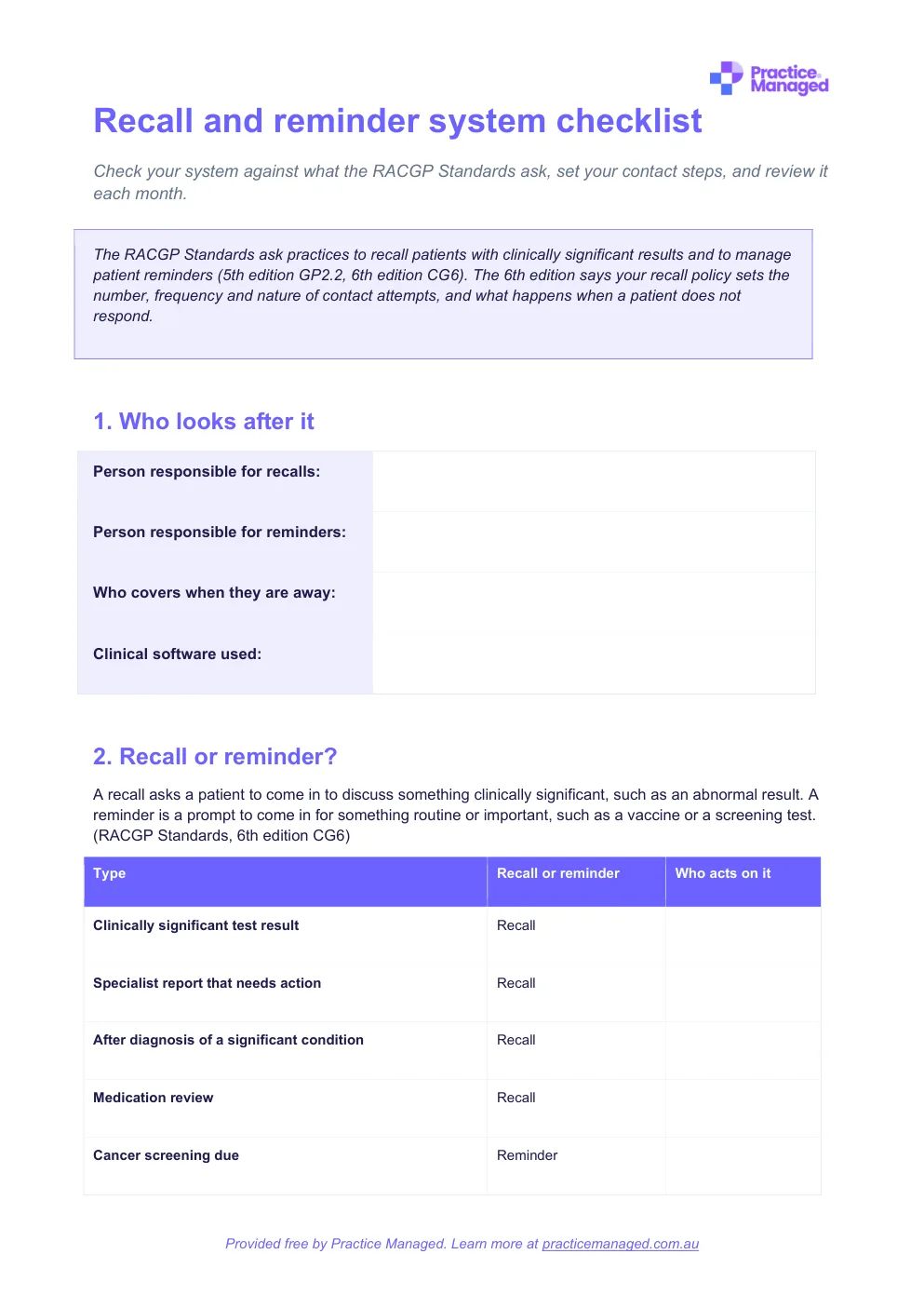
- Who looks after it: the people responsible for recalls and reminders, and who covers when they are away.
- Recall or reminder: the RACGP's meanings, with common types such as significant results, medication reviews, cancer screening and vaccines.
- Eleven checks, such as a written recall policy, safe contact channels, text message consent and recording every attempt.
- Example contact steps for a recall, based on the RACGP's example and MDA National's advice, ready to change.
- A monthly check table and a review date.
Who fills it in, and when
The people responsible for recalls and reminders fill it in, with a GP for the clinical parts. Work through the checks once when you set up or review your system, and again after any incident. Fill in the monthly check table each month when you run the recall list in your clinical software.
How to use it
- Name the people responsible and work through the eleven checks.
- Set your own contact steps and put them in your recall policy.
- Run the recall list once a month and record the check in the table.
Recall and reminder system checklist
Word · 74 KB · free
Which RACGP Standards it helps with
Supports 5th edition criterion GP2.2 (Follow-up systems), which asks practices to recall patients with clinically significant results and manage patient reminders, and 6th edition criterion CG6 (Follow-up systems), whose guidance says the recall policy sets the number, frequency and nature of contact attempts and what happens when a patient does not respond.
- 5th edition: GP2.2 Follow-up systems
- 6th edition: CG6 Follow-up systems
An example
Example only: a clinically significant result needs a recall. Step 1, phone call on Monday morning, no answer. Step 2, phone call on Tuesday afternoon, no answer. Step 3, phone call on Wednesday evening, no answer. Step 4, text by the patient's preferred way: Please call the practice about your recent visit. Each attempt is written in the patient's health record.
Common mistakes to avoid
- Putting the result itself in a text message or voicemail.
- Closing a recall because the patient could not be reached, without a clinician's advice.
- Texting a patient who never agreed to receive texts.
Goes well with
It goes with our guide Patient recalls and reminders: setting up a system that works.
Want to know where the rest of your practice stands? Take the free readiness check: ten yes-or-no questions, your score straight away, and a to-do list sent to your inbox.