Emergency plan template for GP practices
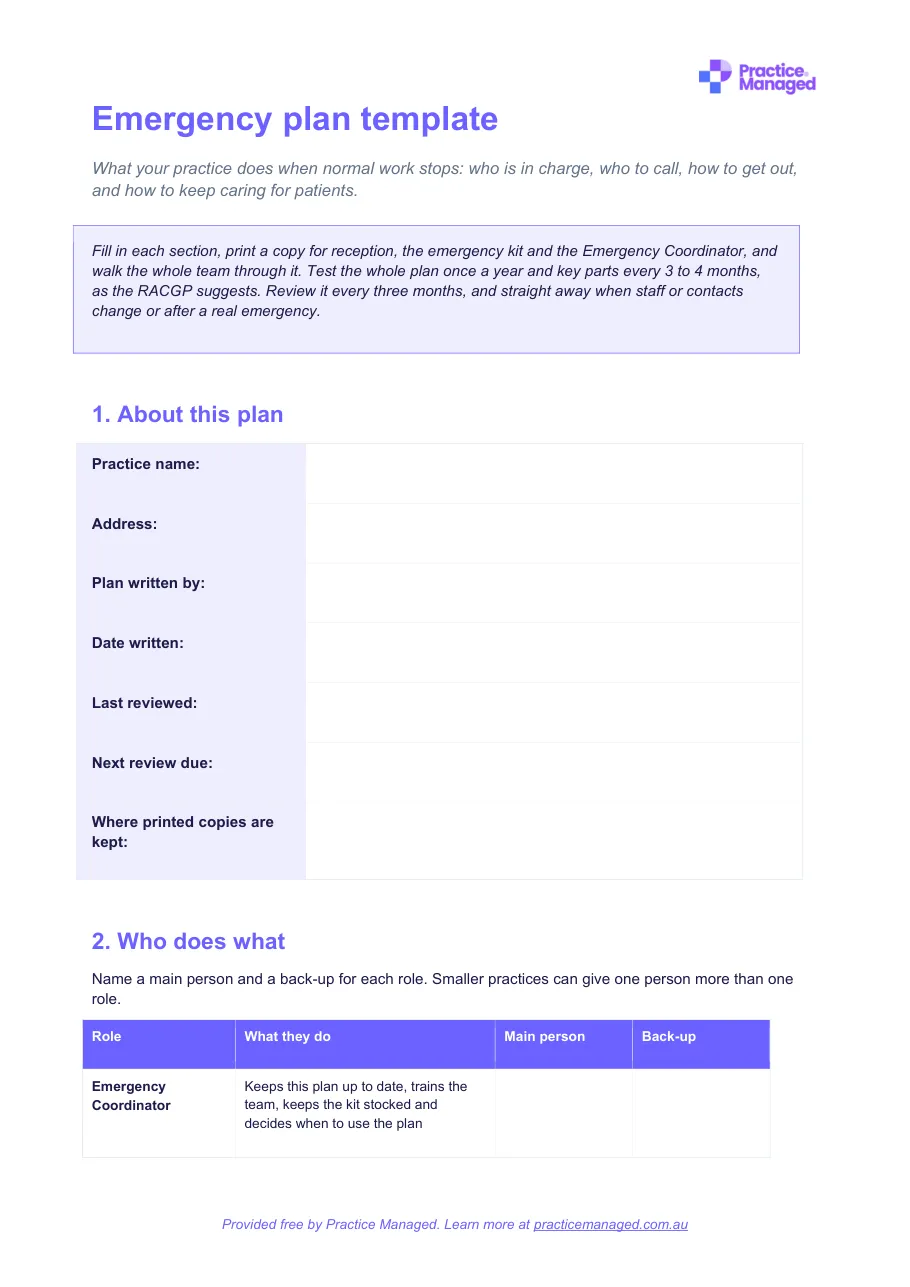
A section for each part of your emergency plan, ready to fill in, print and walk your team through.
What's inside
- Who does what: the Emergency Coordinator, a deputy and other roles.
- Risks for your practice, contacts, the floor plan, getting everyone out, running without computers, backups and power failure.
- Telling patients, a threatening person, the emergency kit checklist, getting back to normal, and a testing and review log.
Who fills it in, and when
The Emergency Coordinator writes and keeps the plan, with a deputy who steps in when they are away. The file says to test the whole plan once a year and key parts every 3 to 4 months, as the RACGP suggests. Review it every three months, and straight away when staff or contacts change or after a real emergency. Smaller practices can give one person more than one role.
How to use it
- Fill in each section for your practice.
- Print copies for reception, the emergency kit and the Emergency Coordinator.
- Walk the whole team through it, test it, and review it regularly.
Emergency plan template
Word · 76 KB · free
Which RACGP Standards it helps with
Supports 5th edition criterion C3.3 (Emergency response plan) and 6th edition criterion F2 (Response planning), which asks for a tested plan for when your services are disrupted. The 6th edition also asks for a way to keep caring for patients when computers fail, which section 7 (Running without computers) covers.
- 5th edition: C3.3 Emergency response plan
- 6th edition: F2 Response planning
An example
Example only, section 14 (Testing and review log): 12 May, evacuation drill. What we learned: the back door sticks. Changes made: door repaired, meeting point moved to the car park. Initials: JC. In section 2, the same practice lists Jo Citizen (practice manager) as Emergency Coordinator, with Sam Lee (senior receptionist) as back-up.
Common mistakes to avoid
- Naming only one person for a role: the file asks for a main person and a back-up for each one.
- Keeping the only copy on the computer: print copies for reception, the emergency kit and the Emergency Coordinator.
- Writing the plan and never testing it: record each test, what you learned and what you changed in the log.
Goes well with
It goes with our guide An emergency plan for your GP practice: what to put in it.
Want to know where the rest of your practice stands? Take the free readiness check: ten yes-or-no questions, your score straight away, and a to-do list sent to your inbox.