WHS hazard and risk register
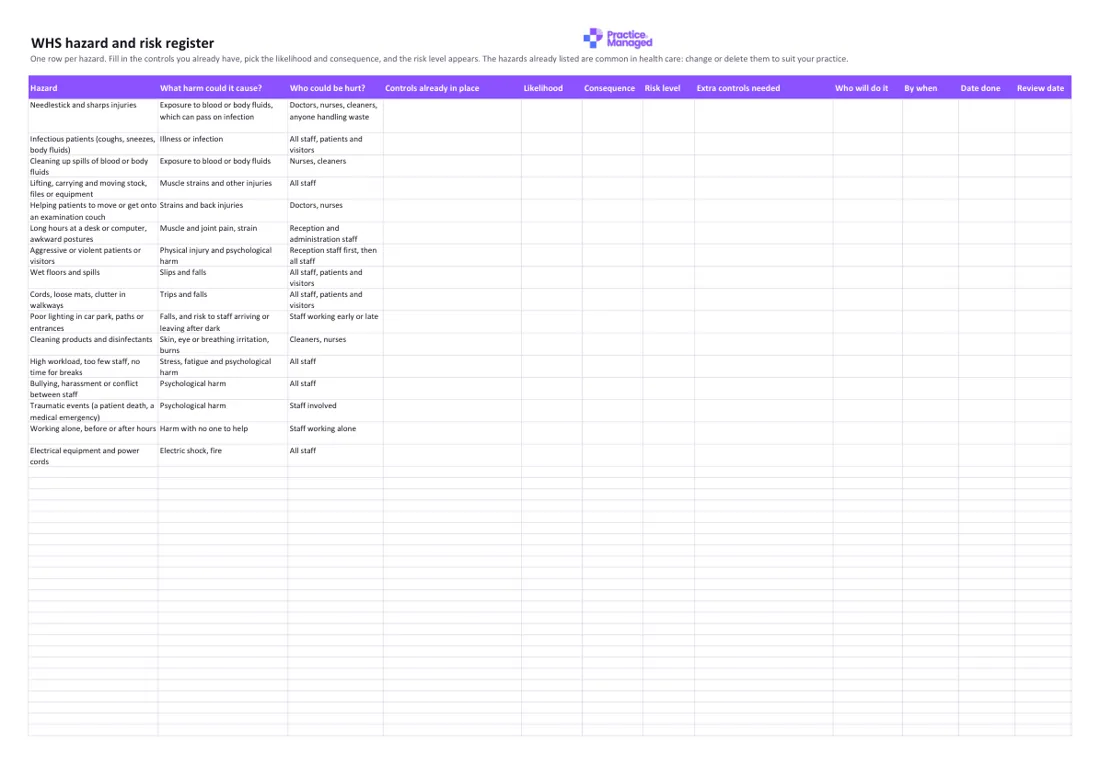
One row per hazard. Write the controls you already have, pick how likely and how bad the harm could be, and the register shows the risk level. Then write what else needs doing, who will do it and by when.
What's inside
- Risk register: hazard, harm, who could be hurt, current controls, likelihood, consequence, risk level, extra controls, who, by when, date done and review date.
- 16 common hazards already listed, such as needlestick injuries, manual tasks, aggressive patients, slips, cleaning chemicals and high workload.
- How to rate: Safe Work Australia's five likelihood levels and a simple chart that turns each rating into Low, Medium or High.
- First aid kit check: the example kit contents from Safe Work Australia's first aid code of practice, with columns for quantity, expiry and restocking.
- How to use it: the four steps to manage risk, the hierarchy of controls, when to review and which incidents to report.
Who fills it in, and when
The practice manager usually keeps it, working with the team. Fill it in when you set it up, walking through the practice and asking staff what worries them. Add a row whenever you find a new hazard, after an incident or near miss, and before a change such as new equipment, rosters or a fit-out. Give every row a review date. Check each first aid kit after it is used, or at least once every 12 months.
How to use it
- Walk through the practice with your team and change or add hazards on the Risk register tab.
- Rate each hazard, then add extra controls, who will do them and by when.
- Check overdue dates (shown in red) each month, and check each first aid kit after use or at least every 12 months.
WHS hazard and risk register
Excel · 52 KB · free
Which RACGP Standards it helps with
Supports 5th edition criterion C3.5 (Work health and safety), which asks practices to support the safety, health and wellbeing of the team, and 6th edition criterion F7 (Practice team culture, safety and involvement), which asks for a WHS policy, managing occupational exposures and protecting staff from violence and aggression. The register follows the steps in Safe Work Australia's code of practice, How to manage work health and safety risks.
- 5th edition: C3.5 Work health and safety
- 6th edition: F7 Practice team culture, safety and involvement
An example
Example only: Hazard: wet floors and spills. Who could be hurt: all staff, patients and visitors. Controls already in place: spills cleaned up when seen. Likelihood: Possible. Consequence: Moderate. The register shows Medium. Extra controls needed: spill kit at the front desk and non-slip mats fixed at the entrance. Who will do it: practice manager. By when: 30 January 2027. Review date: 30 July 2027.
Common mistakes to avoid
- Rating a risk before writing down the controls you already have: the rating is meant to show the risk with those controls in place.
- Relying only on training, signs or gloves: the file explains these are the weakest controls, so look for a stronger one first.
- Leaving the review date blank: without it, the row never turns red when a review is overdue.
Goes well with
It goes with our guide Work health and safety in a GP practice: a practical guide for practice managers.
Want to know where the rest of your practice stands? Take the free readiness check: ten yes-or-no questions, your score straight away, and a to-do list sent to your inbox.